24/7 Emergency Tree Services in Volusia County: Fast, Reliable Tree Removal and Storm Cleanup

24/7 Emergency Tree Services in Volusia County: Fast, Reliable Tree Removal and Storm Cleanup
Emergencies involving trees demand immediate attention to protect life and property. This guide explains what qualifies as an emergency, how professionals respond, and what property owners should expect in Volusia County. Readers will learn clear criteria for emergency calls, step-by-step response workflows, the types of emergency services available after storms and hurricanes, and transparent cost and permitting guidance relevant to local homeowners. The article references essential storm-season realities for Volusia County and uses practical lists, quick-reference tables, and timeline checklists so you can act quickly when a hazardous tree event occurs. Throughout the piece, we use keywords like emergency tree services, storm damage cleanup, 24/7 tree service, and urgent tree removal Volusia to improve discoverability and ensure the content answers both urgent practical questions and planning needs. After covering qualifying scenarios and operational workflows, the guide dives into service types, cost factors and insurance interactions, permit requirements, local coverage across Volusia cities, and a final section that sets expectations for arrival, on-site procedure, and cleanup standards.
What Qualifies as an Emergency Tree Service in Volusia County?
An emergency tree service is any tree situation that presents an immediate risk to people, structures, utilities, or safe access; the defining mechanism is imminent failure or impact that requires rapid mitigation to prevent harm. Recognizing an emergency fast improves safety and reduces further property damage, so homeowners should evaluate visible structural compromise, contact lines, and any tree-on-structure scenarios first. This section defines qualifying scenarios and outlines why certain conditions demand 24/7 intervention, helping property owners prioritize calls during storms or isolated failures. Understanding these thresholds prepares residents to make informed calls and to document conditions for insurance or permit purposes.
Which Tree Situations Require Immediate Attention?
Certain tree failures create immediate hazards and require emergency response to protect people and property. Fallen trees on homes, vehicles, or people are top-priority scenarios because weight and shifting debris can collapse roofs, trap occupants, or cause injury; homeowners should keep clear of the area until professionals secure it. Severed branches and hanging limbs over driveways, patios, or sidewalks present unpredictable fall risk and need prompt removal to prevent injury or secondary damage. Trees that suddenly lean after root failure or show large trunk cracks indicate structural instability and should be treated as urgent because the entire canopy can fail without warning.
How Do Storms and Hurricanes Impact Emergency Tree Needs?
Storms and hurricanes increase both the frequency and complexity of emergency tree calls by producing high winds, saturated soils, and flying debris that compromise root systems and branches. During hurricane season, uprooted trees and whole-tree failures become common, raising risks to structures, vehicles, and powerlines and necessitating rapid removal and debris clearance to restore safe access. High-demand periods also require triage and prioritization: responders focus on life-safety jobs first, then clear access routes and critical infrastructure before non-critical cleanups. Preparing for surge conditions and understanding triage priorities helps homeowners set realistic expectations for arrival times and service sequencing.
Research into hurricane debris and damage assessment in Florida urban forests indicates that tree canopy, wind speed, and the percentage of urban developed land significantly affect the amount of debris generated.
Hurricane Debris and Damage Assessment for Florida Urban Forests
ABSTRACT: AbstractListenA random 10% sample of communities in highly-impacted counties from the 2004 and 2005 Florida, U.S. hurricane seasons were used to study tree debris generation and damage from seven hurricanes. Woody debris amounts in cubic meters (m3) (cubic yards; yd3) as well as rates and costs for cleanup, tree removal and pruning were obtained for these events. Average debris generation per 30.5 m (100 ft) of street segment ranged from 0.59 m3(0.77 yd3) for low damage, 3.4 m3(4.44 yd3) for moderate damage, and 17.47 m3(22.85 yd3) for high damage levels; cost of removal and disposal averaged $28.25 per m3($21.47 per yd3). Most communities used unit costing to account for tree removal and pruning rates, averaging 2% and 28% of street trees, respectively. Tree canopy, wind speed, and percentage of urban developed land all had a significant effect on debris amount. Florida communities with a greater tree density generated decreased amounts of debris during the 2004 and 2005 hurricane sea
What Are the Risks of Delaying Emergency Tree Removal?
Delaying removal of a hazardous tree can escalate damage, increase costs, and complicate insurance claims because continued exposure and subsequent failures multiply repair needs. A compromised tree left unattended may drop additional limbs, worsen roof or siding damage, or bring down utility lines during subsequent weather events, creating cascading hazards. Insurance adjusters often consider whether a homeowner acted reasonably to mitigate risk; documented delay can complicate claims or reduce recoverable costs. Prompt intervention reduces structural deterioration, limits secondary failures, and speeds recovery—outcomes that improve safety and preserve insurance support.
How Does Our 24/7 Emergency Tree Service Work in Volusia County?
This section explains the operational workflow from your initial contact through job completion and shows how rapid triage, professional equipment, and safety protocols create efficient emergency outcomes. The process emphasizes fast response windows, clear homeowner actions during dispatch, on-site assessment and containment, methodical removal, and thorough cleanup with follow-up inspection. Understanding these operational steps helps homeowners know what information to provide and what to expect when crews arrive, improving safety and minimizing disruption. After describing the timeline and equipment, the final subsection details how safety and communication practices protect property and maintain customer satisfaction.
What Are the Steps from Your Call to Tree Removal Completion?
A structured call-to-completion timeline ensures that urgent needs are assessed and addressed efficiently while keeping homeowners informed and safe. First, dispatch intake captures key facts—location, immediate hazards, and whether people or structures are involved—so crews can prioritize life-safety calls and assemble appropriate equipment. Next, the team provides an estimated arrival window and performs remote triage if possible, advising homeowners to secure pets and keep clear of the hazard zone. On arrival, crews perform an on-site assessment, secure the area with barriers or traffic control as needed, and implement a removal plan that protects structures and utilities before cutting and hauling debris. Finally, crews complete a cleanup pass, document the work, and offer a post-job walkthrough explaining any follow-up steps such as stump grinding or additional stabilization.
Which Professional Equipment Do We Use for Fast and Safe Removal?
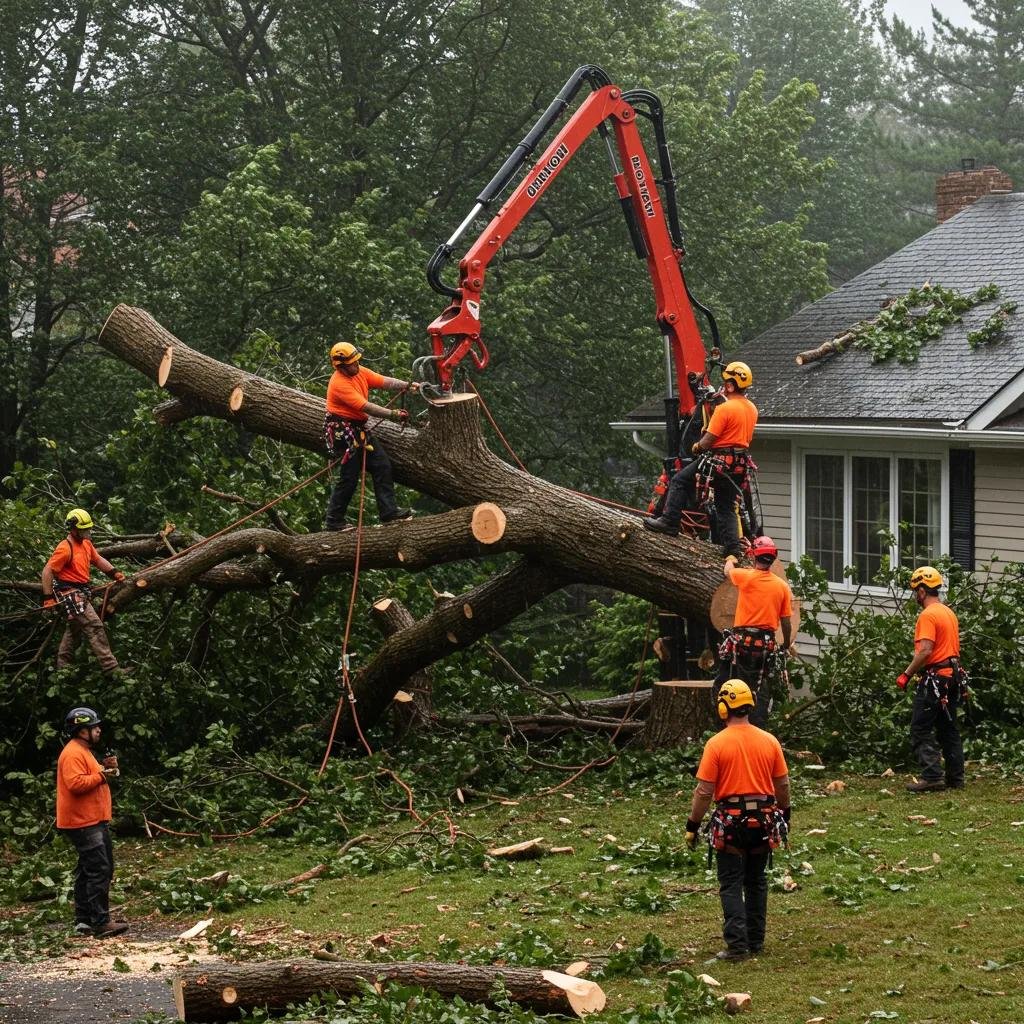
Professional-grade equipment enables faster, safer emergency work by reducing manual risk and improving debris handling efficiency. Grapple trucks and skid-steer loaders speed bulk debris removal and hauling, allowing crews to clear access routes quickly and reduce on-site time. Cranes and aerial lifts facilitate careful removal of heavy branches and tree sections from roofs or near utilities, preventing collateral damage when trees must be dismantled piece-by-piece. Mobile chippers and stump grinding units convert debris to manageable volumes and remove hazardous stumps, while chainsaw crews and certified rigging techniques execute precise cuts under controlled conditions. Using the right machinery tailored to the scenario reduces risk and shortens restoration timelines.
How Do We Ensure Safety and Customer Satisfaction During Emergencies?
Safety protocols and clear communication form the foundation of reliable emergency tree service and protect both people and property during high-stress events. Crews follow site-control procedures—establishing exclusion zones, coordinating with utility providers when lines are involved, and using personal protective equipment and certified rigging methods to manage falling loads. Documentation of the assessment and the removal plan supports insurance claims and clarifies homeowner expectations about scope and timing. Licensed and insured professionals ensure accountability and financial protection for both workers and property owners, and transparent updates during the job maintain customer confidence. These practices result in safer removals, documented outcomes, and higher satisfaction even under emergency conditions.
Effective emergency response relies on adaptive workflows that prioritize information sharing to improve efficiency and mitigate errors.
Adaptive Workflow Simulation for Emergency Response Efficiency
Recent incidents and major training exercises in and outside the Netherlands have persistently shown that not having or not sharing information during emergency response are major sources of emergency response inefficiency and error, and affect incident mitigation outcomes through workflow planning that is based on this information. In this dissertation the grounded development and initial testing of the Adaptive Workflow Simulator (AWS) was presented. The goal of the AWS is to simulate and on the fly provide information about the current state of the workflow, workload and communication load of emergency responders during emergency response situations as a function of the information that is exchanged. As a function of the information flow, the AWS is used to approximate the workflow; approximate the strain put on the emergency responders as a consequence of task execution and handling information, and finally provide a test bed for to assess the impact of information distribution on
What Types of Emergency Tree Services Are Available in Volusia County?
Emergency tree services cover a spectrum from single-tree removals to large-scale storm debris management; each service type addresses specific scenarios and requires matching equipment, crew size, and response priorities. This section explains common emergency offerings—storm damage cleanup, hazardous tree removal, fallen tree removal, and hurricane-specific response—and clarifies what homeowners can expect in terms of actions and timelines. Understanding these service differences helps homeowners request the right response and anticipate resource needs for safe, efficient resolution. Below is a comparative table summarizing service types, typical scenarios, and response/equipment expectations to make choices clearer.
| Service Type | Typical Scenario | Response Time / Equipment Used |
|---|---|---|
| Storm damage tree cleanup | Multiple downed limbs and blocked access after high winds | Rapid triage, grapple trucks, chippers; prioritized clearing of life-safety and access routes |
| Hazardous tree removal | Leaning trunk, large cracks, or diseased structural failure | Timely response, cranes or aerial lifts for safe dismantling, rigging and traffic control |
| Fallen tree removal | Tree on roof, vehicle, or driveway | Immediate response for life-safety, cranes for roof lifts, structural protection measures |
| Hurricane surge response | Widespread uprooting and debris across neighborhoods | Surge crews, staged equipment, coordination with local authorities, multi-day operations |
This comparison clarifies how different emergency needs map to equipment and timelines so homeowners can match responses to their situation.
How Is Storm Damage Tree Cleanup Performed?

Storm damage cleanup begins with triage—identifying life-safety hazards, access-blocking debris, and hazards to utilities—so crews can sequence work where it matters most. Initial actions focus on removing immediate threats and opening driveways or roadways to allow emergency access, using grapple trucks and loaders to haul large volumes of debris quickly. After priority routes are cleared, crews perform more detailed removals around structures, apply structural protection where trees contact buildings, and chip or haul remaining material for disposal. Coordination with utility providers or local authorities may be necessary when lines are involved, and homeowners should expect staged operations during widespread storm events.
When Is Hazardous Tree Removal Necessary?

Hazardous tree removal is warranted when inspection reveals clear indicators of imminent failure that threaten people or structures, such as root plate separation, large trunk fissures, significant lean, or advanced decay. Professionals assess structural integrity, canopy weight distribution, and proximity to vulnerable targets to determine urgency and the safe removal approach. In some cases, short-term stabilization—such as cabling—can buy time for scheduled removal, but visible failure signs typically require prompt dismantling to eliminate the immediate risk. Clear documentation of hazardous indicators also helps support permit or insurance processes when removal proceeds.
What Does Fallen Tree Removal Include?
Fallen tree removal on a property includes initial assessment, sectional cutting to relieve weight, structural protection where trees contact roofs or walls, controlled lifting and removal of heavy sections, and cleanup or hauling of debris. Teams work methodically to avoid further roof damage by using cribbing, slings, and cranes when necessary, and they communicate sequencing so homeowners know when re-entry is safe. Cleanup can include bulk hauling, chipping on-site, and offering optional follow-on services such as stump grinding or grading to prepare the site for restoration. Homeowner involvement is usually limited to securing the area and providing site access for crews.
How Do We Handle Emergency Tree Removal After Hurricanes?
After hurricanes, responders deploy surge-capacity operations that include staged crews, centralized staging yards for equipment, and a triage system prioritizing life-safety and critical infrastructure restoration. Large events often require multi-day efforts and coordination with municipal debris management plans, meaning some non-life-safety jobs may wait while emergency routes and utilities receive priority. Homeowners should expect longer timelines during peak recovery but can prepare by documenting damage, securing salvageable property, and maintaining clear access for crews. Surge responses maximize efficiency by concentrating resources where they restore safety and access fastest.
Guidance for assessing and restoring trees after a hurricane in Florida emphasizes chainsaw safety, hiring professionals, identifying salvageable trees, and proper pruning techniques.
Assessing Damage and Restoring Trees After a Hurricane in Florida
ABSTRACT: AbstractENH-1036, a 16-page full-color fact sheet by Edward F. Gilman, Mary L. Duryea, Eliana Kampf, Traci Jo Partin, Astrid Delgado, and Carol Lehtola was funded by the Florida Division of Forestry and the USDA Forest Service, Southern Region as part of the Urban Forest Hurricane Recovery Program. Includes sections with guidelines for chainsaw safety, how to hire tree care professionals, how to tell which damaged trees can recover and which should be removed, how to restore trees to health after a hurricane by pruning — both immediately after the storm and after few years’ growth, specialized information for dealing with palm and pine trees, how to prevent damage by using effective design and management practices, and lists of decay resistant and wind resistant tree species for Florida. Published by the UF Department of Environmental Horticulture, July 2006.
How Much Does Emergency Tree Removal Cost in Volusia County?
Emergency tree removal costs vary widely based on quantifiable factors; transparent pricing hinges on tree size, accessibility, severity of damage, and the specialized equipment required. Typical emergency jobs can range from lower-cost single-tree removals to higher-cost complex rescues involving cranes and structural protection—understanding cost drivers helps homeowners evaluate estimates and plan financially. The following table breaks down cost components against typical price-range brackets to make comparisons easier and support quick decisions during urgent events.
| Cost Component | What It Reflects | Typical Impact on Price |
|---|---|---|
| Tree size and DBH | Larger diameter increases cutting and removal time | Moderate to High |
| Location & access | Tight yards, fences, or roof entanglement require more labor/equipment | High |
| Damage severity | Tree-on-structure or utility involvement needs careful methods | High |
| Equipment needs | Crane, grapple truck, or aerial lift rental increases cost | High |
| Time & surge demand | Emergency or after-hours response may include surcharges | Moderate |
This comparison clarifies how each attribute influences final cost so homeowners can interpret estimates and ask targeted questions during emergencies.
What Factors Affect Emergency Tree Removal Pricing?
Several discrete factors influence pricing and the mechanism by which they drive cost relates to time, risk, and specialized resources required for safe removal. Tree height and trunk diameter directly increase labor hours and cutting complexity, while proximity to structures or fences raises the need for protective systems and careful piece-by-piece removal. Limited access or obstructed sites often require heavier machinery (crane or grapple truck), which adds rental and operator costs; emergency timing and surge demand during storms can also introduce after-hours charges. Reviewing these factors with any estimator helps homeowners understand and compare bids effectively.
Does Homeowners Insurance Cover Emergency Tree Services?
Homeowners insurance often covers tree removal when a fallen tree damages a covered structure or when removal is necessary to protect a covered structure, but policies vary on debris removal caps and exclusions. If a tree falls without striking a structure, coverage for removal may be limited or excluded, though some policies include debris removal allowances; documenting damage with photos and dated notes improves claim processing. Homeowners should notify their insurer promptly, preserve evidence, and request guidance on preferred documentation; contractor documentation of hazardous conditions and remediation steps also supports claims. Clear communication between the homeowner, contractor, and insurer accelerates approval for covered work.
How Can Property Owners Prepare Financially for Emergency Tree Removal?
Practical financial preparation reduces stress during emergencies and involves reviewing policy limits, establishing an emergency fund for deductibles, and securing contractor contacts before storms. Conducting pre-season risk assessments identifies trees likely to cause problems and can guide proactive trimming or removal that is typically less costly than emergency response. Requesting free estimates from licensed and insured professionals ahead of storm season creates a baseline for expected costs and helps compare emergency response pricing later. Keeping documentation of prior inspections and a prioritized list of hazardous trees can streamline decision-making when urgent removal becomes necessary.
What Are the Permit Requirements for Emergency Tree Removal in Volusia County?
Permit requirements depend on local ordinances, protected species, tree size thresholds, and conservation overlays; emergency pathways usually exist to expedite removal when life-safety or immediate property protection is at stake. This section summarizes common triggers for permits, quick steps to obtain emergency authorization, and typical penalties for unauthorized removal, giving homeowners the procedural clarity they need during crises. A concise table below outlines permit types, when they apply, and how quickly emergency permits may be processed to help homeowners act in compliance while addressing hazards.
| Permit Type | When Required | How Quickly Obtained |
|---|---|---|
| Protected-species/tree permit | Removal of protected trees or those above municipal size thresholds | Emergency exemptions often same-day to multi-day with documentation |
| Historic or conservation overlay permit | Trees in designated districts or conservation areas | Emergency relief issued quickly when life-safety demonstrated |
| Standard removal permit | Non-emergency removals exceeding local size limits | Normal review cycles apply; not for immediate hazards |
This table helps homeowners identify whether a permit is likely required and how emergency pathways typically shorten regular review times when immediate danger exists.
When Is a Permit Required for Emergency Tree Removal?
A permit is commonly required when removing trees that meet local size thresholds, are protected species, or are located within conservation or historic districts; these rules aim to balance preservation with safety. Exemptions typically apply when imminent life-safety is at stake; in such cases, documentation—photos, inspector notes, or contractor assessment—supports retroactive permit filings. Homeowners facing unclear rules should document the hazard thoroughly before removal and contact local authorities as soon as it is safe to do so to secure post-event authorization. Proper documentation helps mitigate potential penalties for emergency removals carried out under immediate threat.
How Can Property Owners Obtain Emergency Tree Removal Permits Quickly?
Quick permit pathways usually require clear documentation of the hazard, including dated photos, a concise damage statement, and evidence of structural risk, which expedites municipal review. Homeowners should gather this information promptly and present it with the contractor’s assessment to the county’s emergency permitting office or through designated emergency permit channels. Regular follow-up and maintaining records of all communications speeds processing; contractors experienced with local procedures can often assist by preparing required paperwork and liaising with officials. Keeping records and working collaboratively with authorities reduces delays and supports retroactive compliance if immediate removal is necessary.
What Are the Penalties for Removing Trees Without Permits?
Removing regulated trees without required permits can trigger fines, restoration orders, or remediation requirements depending on municipal codes; penalties incentivize proper permitting and preservation. However, documented life-safety emergencies often lead to reduced enforcement if homeowners can show immediate danger and proper documentation was filed promptly afterward. To mitigate penalties, retain photos, an expert assessment, receipts, and any emergency permit filings or municipal correspondence showing post-removal reporting. When in doubt, consult local authorities before non-urgent removal to avoid fines and ensure compliance.
Which Areas in Volusia County Do We Serve for 24/7 Emergency Tree Services?
Service coverage includes named cities across Volusia County with response profiles tailored by urban density and coastal exposure; understanding local response expectations helps homeowners anticipate arrival windows and resource staging. This section lists major service areas, highlights common emergency scenarios by locality, and explains how geography affects response time and equipment needs. Readers in Daytona Beach, DeLand, Port Orange, Ormond Beach, New Smyrna Beach, and Deltona can use these descriptions to set realistic expectations and prepare for service requests.
What Emergency Tree Services Are Available in Daytona Beach and Surrounding Cities?
Coastal areas like Daytona Beach often face elevated hurricane and tropical storm risk, resulting in a higher incidence of uprooted trees, salt-spray stress, and wind-thrown limbs that threaten structures and roadways. Emergency services in these zones prioritize storm surge impacts and access clearance, using grapple trucks and staged crews to restore main thoroughfares and life-safety access. Coordination with local authorities is common when roads or public infrastructure are affected, and homeowners should expect surge scheduling during widespread events. Prepared documentation and immediate reporting of life-safety incidents ensure prioritized response.
How Do We Support Property Owners in DeLand, Port Orange, and Ormond Beach?
Suburban inland communities such as DeLand, Port Orange, and Ormond Beach present varied access conditions and species types that influence failure modes; root failure in saturated soils and oak limb drop are frequent issues. Emergency crews serving these areas balance rapid arrival with careful dismantling near structures and trees in tight yards, selecting equipment that minimizes collateral property disturbance. Availability of multiple crews and staged equipment in nearby hubs improves turnaround for these suburban zones, and homeowners benefit from pre-storm assessments to identify high-risk trees before they fail.
Can We Respond Quickly to Emergencies in New Smyrna Beach and Deltona?
Response windows for towns like New Smyrna Beach and Deltona vary by distance from staging areas and storm-driven demand, but prioritized life-safety calls typically receive the fastest response. Urban sections may see quicker arrival due to denser crew coverage, while rural or hard-to-access properties can require additional mobilization time and specialized equipment. During major events, crews triage calls and allocate resources to life-safety and access-restoration first, so homeowners should report hazards early, provide clear location details, and secure pets and people until crews arrive.
What Should Property Owners Expect During an Emergency Tree Service Call?
Knowing the typical timeline and on-site process reduces confusion and improves safety when an emergency crew is dispatched; this section lays out realistic arrival windows, the sequence of on-site actions, cleanup standards, and answers to common homeowner concerns. A clear numbered timeline targets featured-snippet style clarity to help homeowners decide when to call 911 versus when to contact emergency tree services, and it explains the homeowner’s role during the response. The following numbered timeline summarizes the process from call to completion.
- Call intake and triage: Provide location, hazard description, and whether people or utilities are involved.
- Dispatch and estimated arrival: Team assigned with equipment appropriate to the scenario.
- On-site assessment and safety setup: Crew secures the scene, coordinates utilities if needed, and confirms removal plan.
- Removal, lifting, and protection: Controlled dismantling or heavy-lift operations executed to protect structures.
- Cleanup and documentation: Debris removal, chipping or hauling, and post-job walkthrough with homeowner.
This timeline clarifies expectations and helps homeowners prepare for each stage of the emergency response.
How Quickly Can Emergency Tree Services Arrive After Your Call?
Arrival times depend on triage priority, distance, traffic, and concurrent storm demand; life-safety incidents generally receive the fastest mobilization and may be attended within hours, while non-life-safety jobs could be scheduled for later the same day or the next day. During major storms or high-demand periods, surge conditions extend arrival windows as crews prioritize hazards that endanger people, utilities, or primary access routes. Providing precise location details, photos, and confirming safe access routes helps dispatch allocate the right crew and equipment quickly. Understanding these variables helps homeowners set realistic expectations for response timing.
What Is the Typical Emergency Tree Removal Process on Site?
On-site operations follow a predictable sequence designed to minimize risk: assessment, perimeter control, structural protection where trees contact buildings, staged cutting and lifting of heavy pieces, and methodical removal of debris. Crews use rigging, cranes, or aerial lifts as needed to prevent secondary damage, and they coordinate with utility providers if lines are involved to de-energize or protect infrastructure. Homeowner responsibilities are limited to ensuring clear access, securing pets, and maintaining a safe distance while crews work. After removal, crews perform a final inspection to confirm site safety before leaving.
How Do We Handle Cleanup and Property Restoration After Tree Removal?
Cleanup standards typically include chipping and hauling of limbs, removal of logs and hazardous debris, and offering optional services such as stump grinding and grading to restore the site to a usable condition. Full restoration timelines vary with the scope of damage; minor jobs may be cleared in a single visit, while larger hurricane-related operations can require staged follow-up visits for grinding and grading. Disposal follows local regulations and may involve municipal coordination for large volumes. Clear communication about included cleanup services and optional add-ons prevents surprises and ensures agreed-upon expectations are met.
What Are Common FAQs About Emergency Tree Services in Volusia County?
Homeowners frequently ask about permits, cost, insurance coverage, and how to prioritize calls; concise answers help people act quickly and appropriately during emergencies. Questions commonly focus on whether insurance pays for removal, how fast crews can arrive, when permits are required, and when to call 911 instead of a tree service; addressing these clearly avoids confusion during stressful events. Documenting damage, understanding homeowner responsibilities, and maintaining contractor contact information before storms simplifies decision-making. If life-safety is immediately threatened, calling emergency services remains the first step; for urgent but non-life-threatening tree hazards, a licensed emergency tree service should be contacted promptly.
For homeowners who prefer to work with a local contractor, Volusia Bobcat & Tree Service provides licensed and insured emergency crews that offer 24/7 response, professional-grade equipment such as grapple trucks, cranes, and bobcats for safe removals, and free estimates to help homeowners plan financially. To request an emergency assessment or a free estimate, contact Volusia Bobcat & Tree Service directly and provide photos and a clear location to accelerate dispatch and documentation for insurance claims.
Need help with your trees? Visit Volusia Bobcat & Tree Service or call (386) 675-7898 for a free estimate.